Circle of Light Reflects: Sarah Marino on Death Valley
In this series of blog posts celebrating the upcoming release of The Nature of Place: Personal Narratives in Landscape Photography, “Circle of Light Reflects” poses the same six questions to all members of Circle of Light. These six questions are intended to explore the nature of our individual connections with a place that resonates with each of with us in our photographic practice. In this installment, Sarah shares her connection with Death Valley.
1. What would you consider your home place in terms of your photography practice?
Think beyond where you were born or where you live to a place where something in you settles. It might be somewhere you return to often, or somewhere you visited only once but have never quite left.
I end up falling in love with nearly every place I visit for photography but also find returning to a few special places to be at the core of my creative practice. One of those places is Death Valley National Park as a whole and Death Valley in particular. With its basin and range geology, Death Valley National Park includes a series of mountain ranges with flatter, sediment-filled valleys in between, including the namesake 140-mile long Death Valley toward the eastern edge of the park.
2. What first called you to this place, and has that call changed over time?
Was it light? Silence? Something harder to name? And if you now know it more deeply, do you come for the same reasons or has the relationship quietly shifted into something else?
Of all the places I have explored for photography, I have spent the most time in Death Valley, wandering its salt flats, playas, surrounding canyons, and alluvial fans. Many years ago, before I had considered visiting the park myself, my parents brought me a souvenir book, Death Valley: Splendid Desolation, from their brief visit during a long road trip around California. My first reaction was negative, as I couldn’t see myself spending any time in a place called “Death Valley.” After moving beyond that initial snap judgement to a place of greater open-mindedness, the photos of the sparse, other-worldly landscapes from the book sparked my curiosity.
At first glance, the landscape seems desolate, static, and ancient, with heavily eroded, ragged mountains ringing the valley on all sides. With more time, the landscape unfolds as an incredibly bio-diverse and dynamic place. This biodiversity and dynamism are the qualities that keep calling me back. With each rain or wind storm, the landscape feels refreshed and changed. An attentive visitor will quickly realize that they will never visit the same Death Valley twice. As I have spent much more time in the park, I have come to realize how little I know of it, in part because of this dynamic nature and in part because of its vastness. The desire to know the landscape more deeply and completely compels me to continue visiting.
I also feel safe in Death Valley’s familiar, wide-open, minimalist landscapes. This comfort in hiking and exploring by myself brings a type of carefree freedom that I do not experience in other places.
3. Describe this place using only those details a camera cannot capture.
Think of sound, smell, temperature, the particular quality of the air, or that feeling in your body when you arrive. What is present there that never makes it into the frame?
Death Valley is known as being the hottest, lowest, and driest place in North America. While Badwater Basin’s status as the lowest place in North America remains constant, at least in terms of a human lifespan, the qualities of being the hottest and driest change throughout the year. During my most recent trip, my sunrise clothing choices ranged from being fully bundled up with my gloved hands feeling too cold to photograph to wearing shorts and a thin t-shirt to help make the morning heat more tolerable. This variability in weather from fall through winter and into spring creates a range of photographic opportunities while generally being a pleasant place to escape the much colder winters of my home in Colorado’s southwestern mountains. I struggle with very cold weather so being comfortable most of the time makes it easier to feel fully engaged in the creative process.
When hearing others speak about this place, my biggest frustrations comes when Death Valley is characterized as a place of nothingness. For anyone who has visited the park and still uses such words to describe the landscape, I am only left to conclude that they have poor observation skills and did not look very closely at their surroundings. Even at the park’s lowest elevations, plants like desert holly (Atriplex hymenelytra), creosote (Larrea tridentata), and honeysweet (Tidestromia Suffruticosa) thrive in the harsh climate conditions and grow right up to the edge of salt flats and playas. Going a little higher and into the canyons, many dozens of other interesting plants dot the landscape, even in the driest years. While some desert plants, like the desert rock nettle (Eucnide urens), are best left alone, others are friendly to touch and the delightful scents that linger on my fingers deepen my affection for this place — the piney crispness of prairie clover’s (Dalea mollissima) soft leaves, the rich vegetal pungency of sticky arrowleaf (Pleurocoronis pluriseta), and the earthy, slightly citrusy, sharp smell of creosote.
4. Choose one image from this place to share.
Think beyond your finest technical work, or your most awarded. Choose the image that is most true, the one that comes closest to why you keep returning to your home place.
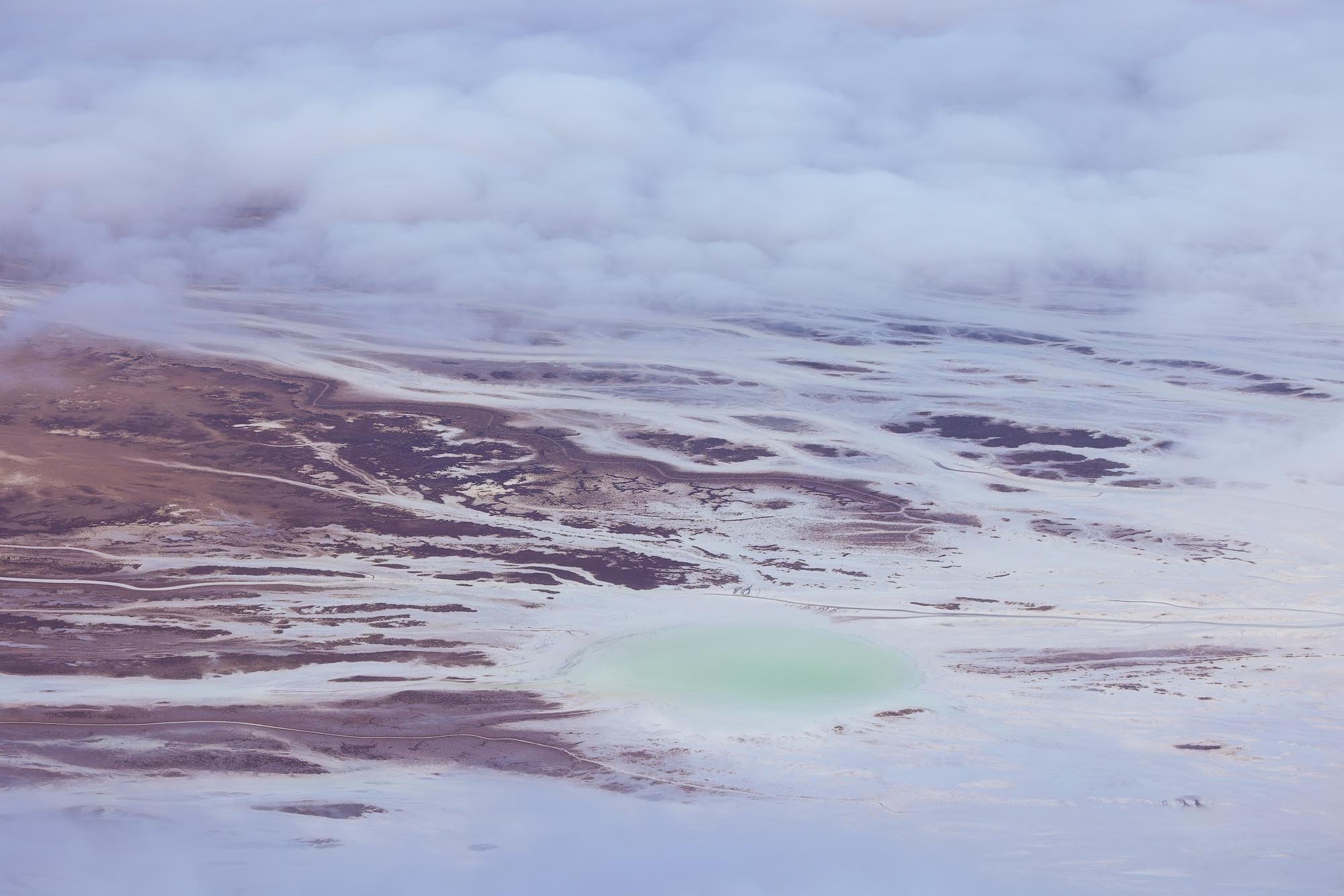
After an intense day of rain, we woke up the next morning to thick fog at our campsite. We drove around in the fog looking for things to photograph but the fog was too thick to see much of anything. I decided to head up to Dante’s View to look down into Death Valley generally, and Badwater Basin specifically, from high above, hoping to get above the cloud deck. For the next hour, I watched as this inversion cleared, revealing the ephemeral Lake Manly below.
Badwater Basin is generally a dry expanse of salt polygons and erratic formations yet in August 2023, Hurricane Helene, and then this rainstorm a few months later, filled the basin with a shallow, temporary lake. Being able to look down into this unfolding scene characterizes what makes this landscape so special to me. It is surreal, otherworldly, endlessly fascinating, mysterious, and constantly changing.
5. What have you learned about yourself through this place?
Places are mirrors as much as subjects. What has this landscape shown you about your own interior terrain—your fears, your longings, your way of seeing?
When I first started visiting Death Valley, I mostly stuck to the established viewpoints and places popularized by others. After coming across a now-defunct website created by an intrepid hiker named Steve Hall, I quickly realized that to really get to know this place, I would need to take a different approach. Through Steve’s journal entries, we learned about off-trail desert hiking and started exploring based on his approach to the park (note: as long as a hiker is not causing damage to the landscape, off-trail and cross-country travel is permitted throughout Death Valley National Park).
With this exploration-oriented approach in mind, we started noticing interesting features off in the distance and then hiked out to see what we might find. We have seen an incredible array of special places, ranging from hidden springs and waterfalls to colorfully beautiful mud formations to rocks wilder than I could have imagined possible. We have hiked to nearly 90 canyons in the park and covered many hundreds of miles across other types of terrain, too. With Death Valley, I have learned that I am more physically and mentally capable in the outdoors than I ever thought I could be.
6. What is one lesson you will take away from one of the essays in The Nature of Place?
In what way has this ebook provoked thought in terms of your photography practice? Will this lesson lead to any change in your philosophy or approach going forward?
Each of the essays in The Nature of Place encouraged me to think about my own creative and photographic practices more deeply or with more nuance, and I am leaving this project with all sorts of threads I want to consider in fresh or different ways. One specific example that keeps coming to mind: Charlotte’s essay is about intuition and after reading her first draft, I realized that I have not given enough thought to the role that intuition plays in my own photography or how I teach photography to others. Before reading her essay, I used “instinct” and “intuition” somewhat interchangeably but now want to explore both ideas to see how they relate and how they are different. I also want to be able to explain what intuition means to me, explore its role in my work with greater clarity and precision, and help others learn how develop and tap into their intuition as part of their creative practice.