Circle of Light Reflects: Charlotte Gibb on Yosemite
In this series of blog posts celebrating the upcoming release of The Nature of Place: Personal Narratives in Landscape Photography, “Circle of Light Reflects” poses the same six questions to all members of Circle of Light. These six questions are intended to explore the nature of our individual connections with a place that resonates with each of with us in our photographic practice. In this installment, Charlotte shares her connection with Yosemite.
1. What would you consider your home place in terms of your photography practice?
Think beyond where you were born or where you live to a place where something in you settles. It might be somewhere you return to often, or somewhere you visited only once but have never quite left.
Yosemite is my home place, without question. I recognized it the first time I visited as a child, long before I had the language to explain why I felt that way. Over time, that early recognition has developed into a photography practice that has intensified my relationship with the park. The work I make in Yosemite feels personal and expressive in a way that is harder to access elsewhere.
2. What first called you to this place, and has that call changed over time?
Was it light? Silence? Something harder to name? And if you now know it more deeply, do you come for the same reasons or has the relationship quietly shifted into something else?
My first impressions of Yosemite were shaped by childhood wonder. I was captivated by the birds and wildlife, and by the scale of the landscape. It felt immense, almost otherworldly, as if I had stepped into a place built on a different set of rules. That sense of wonder never left me, though it has matured over time. What once felt magical is now a deeper kind of affection. I still feel a quiet excitement when I enter the park, but it is paired with a more deliberate way of seeing. Even after years of returning, Yosemite continues to surprise me. There are still corners I have not explored, still moments that shift my understanding. That balance between familiarity and discovery is what keeps me engaged.
3. Describe this place using only those details a camera cannot capture.
Think of sound, smell, temperature, the particular quality of the air, or that feeling in your body when you arrive. What is present there that never makes it into the frame?
I typically enter Yosemite through the south gate, which sits at about 5,000 foot elevation. As soon as I arrive, I roll down all the car windows. The air is cooler and has a distinct clarity not found at lower elevations. It feels like stepping into a different world, both literally and otherwise. As the road descends from there toward Wawona, I breathe in the scent of bearmat (Chamaebatia foliolosa), a fragrant native shrub which grows abundantly along the road. Dry, resinous, and sun-warmed, it is as distinctive as any visual landmark. That scent tells me I am home. It reaches me before any view does. I feel it in my chest, in my breath. I haven’t photographed this plant (yet), but it is always there, shaping how I see the mountains and everything that follows.
4. Choose one image from this place to share.
Think beyond your finest technical work, or your most awarded. Choose the image that is most true, the one that comes closest to why you keep returning to your home place.
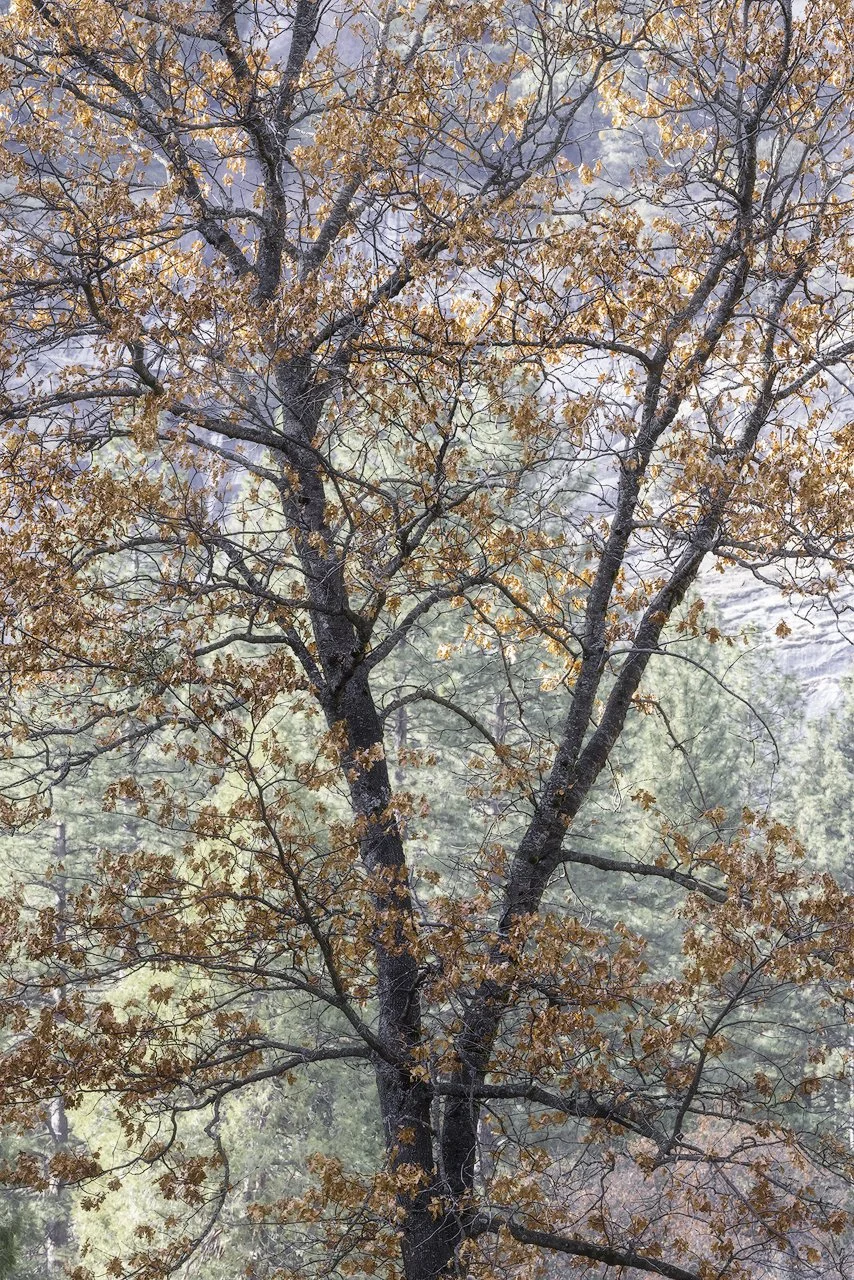
Yosemite Black Oak
5. What have you learned about yourself through this place?
Places are mirrors as much as subjects. What has this landscape shown you about your own interior terrain—your fears, your longings, your way of seeing?
Yosemite has shown me that permanence is often an assumption, not a reality. After a recent winter storm, I walked through areas of the Valley where large black oaks and ponderosa pine had been brought down. The scale of it was sobering. These were trees that had likely stood for generations. It forced me to reconsider what I think of as stable. Even in a place defined by granite and time, change is constant here. What I have learned is that I am no different. The idea of being fixed, of arriving at some finished version of myself, is an illusion. Like the landscape, I am shaped by forces I cannot control. And like the landscape, I continue to change and evolve.
6. What is one lesson you will take away from one of the essays in The Nature of Place?
In what way has this ebook provoked thought in terms of your photography practice? Will this lesson lead to any change in your philosophy or approach going forward?
One of the strongest takeaways from The Nature of Place is the reminder that our relationship to landscape is very much individual as it is fluid. It evolves as we do. Even among six very like-minded photographers, each of us approached “place” from a slightly different perspective. Yet there was clearly a shared approach of attentiveness and connection with our subjects. It reinforced for me that my practice mustn’t stay static. It should continue to evolve with my understanding of my subject and my thinking about my own work.