Circle of Light Reflects: Claudia Welsh on the Northern California Coast
In this series of blog posts celebrating the upcoming release of The Nature of Place: Personal Narratives in Landscape Photography, “Circle of Light Reflects” poses the same six questions to all members of Circle of Light. These six questions are intended to explore the nature of our individual connections with a place that resonates with each of with us in our photographic practice. In this installment, Claudia shares her connection with the Northern California coast.
1. What would you consider your home place in terms of your photography practice?
Think beyond where you were born or where you live to a place where something in you settles. It might be somewhere you return to often, or somewhere you visited only once but have never quite left.
Growing up on the San Francisco Bay Peninsula, the redwoods have always felt like home—like the landscape itself is part of my DNA. Every time Michael and I return to the Northern California coast to host our spring redwoods workshop, something in me exhales. I'm not just visiting a beautiful place; I'm going home. There's a particular quality to that homecoming that I don't experience anywhere else, even in the many extraordinary places photography has taken me. It feels as if the redwoods have always known me, and I suppose it’s because I've always known them.
2. What first called you to this place, and has that call changed over time?
Was it light? Silence? Something harder to name? And if you now know it more deeply, do you come for the same reasons or has the relationship quietly shifted into something else?
It was sensory from the very beginning—the cool, fresh air hitting my face, shafts of light streaming down through the tallest trees, the lush, layered vegetation that seems to grow in every direction. As a child, the redwood forest was simply my favorite place to be. That feeling hasn't changed, but what has changed is that I now have a way to hold onto it. I open my iPhone, stand still, and try to breathe it all in. The fog, the sunbeams, the deep dark comfort of the woods—I find myself not just experiencing these things but looking for how to best capture them and bring them back with me. The call is the same. The response has grown into something more.
3. Describe this place using only those details a camera cannot capture.
Think of sound, smell, temperature, the particular quality of the air, or that feeling in your body when you arrive. What is present there that never makes it into the frame?
There's a particular quality of darkness in the deep woods that I longed for as a child, and still do. Not frightening darkness, but the kind that wraps around me like a shelter. The air is cool and damp in a way that feels almost alive, carrying that rich, earthy scent of moss and bark and soil that no image can hold. The sound is layered: the soft creak of branches, the muffled quiet that only dense forest produces, the occasional drip of condensation finding its way to the ground, or the top of my head. And then there's what happens in the body when I step on the trail—shoulders dropping, breath slowing, some held tension releasing that I didn't even know I was carrying. That feeling of safety. Of being received. That's what I keep returning for. The immersive experience that never quite makes it into the frame, yet the image can take me there in an instant.
4. Choose one image from this place to share.
Think beyond your finest technical work, or your most awarded. Choose the image that is most true, the one that comes closest to why you keep returning to your home place.
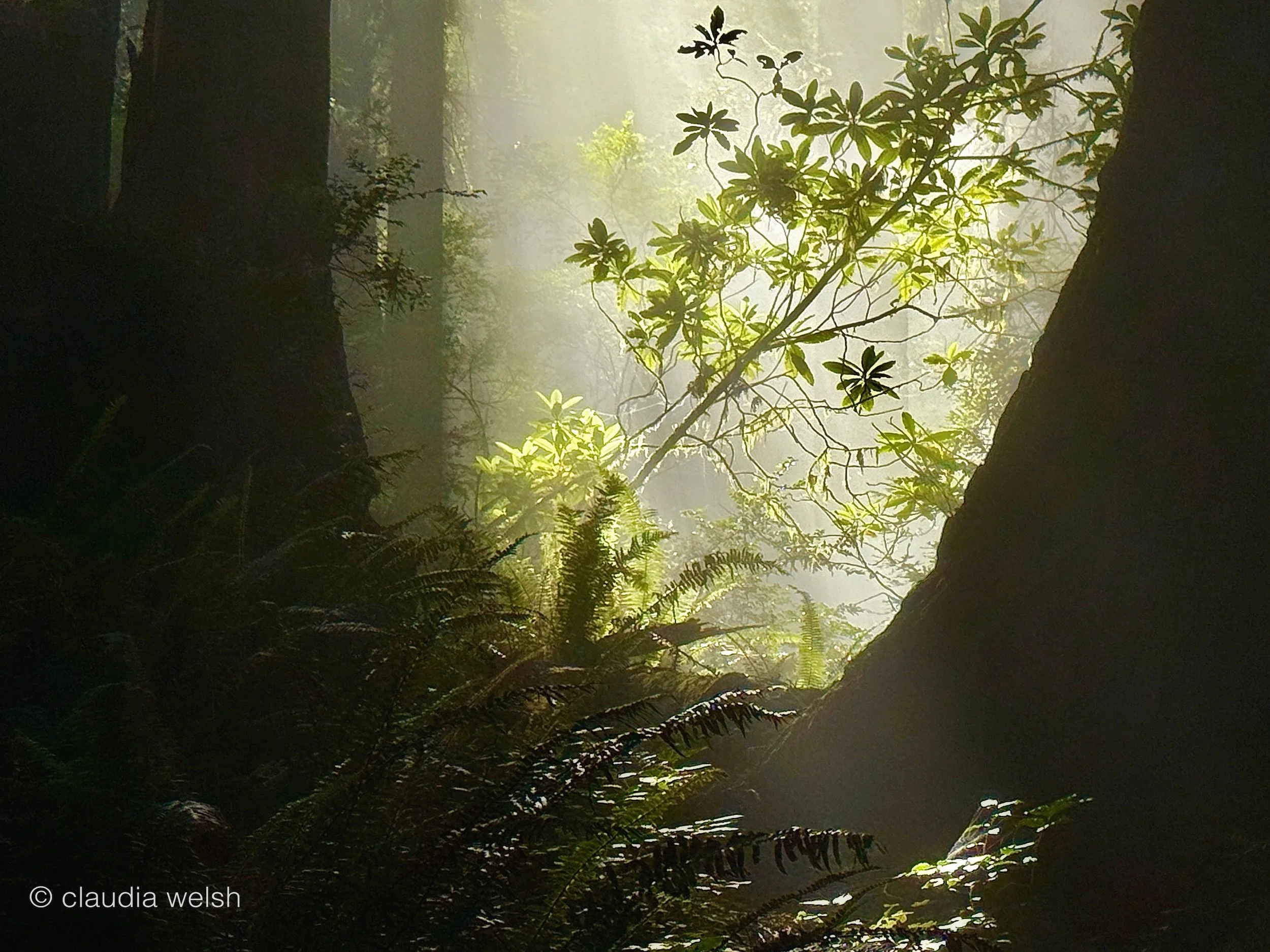
This isn't my most technically polished image from the redwoods, but it's one that feels true. When I look at it, I don't see a photograph—I feel comfort.
5. What have you learned about yourself through this place?
Places are mirrors as much as subjects. What has this landscape shown you about your own interior terrain—your fears, your longings, your way of seeing?
I've learned that I can find something interesting, even beautiful, in almost any natural setting. I've traveled to the Galapagos, Antarctica, the deserts and canyons, the high Sierra, and I've genuinely thrived in all of those places. But what the redwoods have shown me is that there's a difference between thriving and belonging. The places I love most, wherever I am, tend to share something with the forest: a quality of shelter, a certain softness of light, a sense of being held rather than exposed. The redwoods taught me what comfort feels like in a landscape, and that knowledge travels with me everywhere I go. It turns out that what I'm always looking for, in any place, is some echo of that feeling I first found among the tall trees.
6. What is one lesson you will take away from one of the essays in The Nature of Place?
In what way has this ebook provoked thought in terms of your photography practice? Will this lesson lead to any change in your philosophy or approach going forward?
People will often try to tell us who we are. They'll assign a label—to our work, to our approach, to what kind of photographer we're supposed to be. Reading through my fellow photographers' essays in The Nature of Place, what stayed with me most was a kind of quiet permission to resist that. To stay open. Each of these writers brought their own relationship to place, their own philosophy, their own way of seeing. And what struck me was how many of those perspectives resonated with me, and how much richer my own thinking became for having encountered them. When I think back to why I said “yes!” to this project, I’m fairly sure I knew then that it would change me, and help me grow in a good way.
The lesson I'm carrying forward is this: always be open to new experiences, new ideas, new stories. The ones that resonate will do their own work inside you. They'll surface when you least expect it—in the field, behind the lens, in the way you begin to ask different questions of a place. That kind of growth can't be forced. But it can be invited, and this ebook reminded me to keep every door open.