
The True Story of Douglas Falls
Contextual Note: When I was writing my contributions for The Nature of Place: Personal Narratives in Landscape Photography — Circle of Light collective's new ebook — I grappled with the question of what it means to me to be in genuine relationship with the landscapes I photograph. Douglas Falls surfaced during the process, not as a centerpiece, but as an uncomfortable response to Sarah Marino's essay called “The Ponderosa in the Front Yard: Seeing More in the Landscape,” in which she writes about the value of developing reciprocal relationships with the places we photograph and the importance of understanding them. This post ties directly back to my response… Read the full piece on my website.
Orange stained rocks on full display at Douglas Falls, 2013
There is a waterfall in the Potomac Highlands of West Virginia that photographers flock to.
Douglas Falls cascades over a wide sandstone shelf in a hemlock hollow on the North Fork of the Blackwater River near Thomas, and the images made there circulate steadily through the landscape photography community — in portfolios, in social feeds, in workshop itineraries, in photography guides to the region. It isn't hard to understand why. The colors are, upon first encounter, genuinely startling. The rocks are stained deep orange and iron-red. The water, where it pools and cascades, can run aquamarine — a vivid, saturated blue-green that looks, in a photograph, like something from a tropical grotto or a glacial meltwater stream high in the mountains. Together they make an image of almost preposterous beauty. The camera loves it. So do viewers, who have no reason to look further.
I have photographed it. I have shared those images. For some time, though, I didn't look hard enough at what I was actually seeing.
Those Colors..
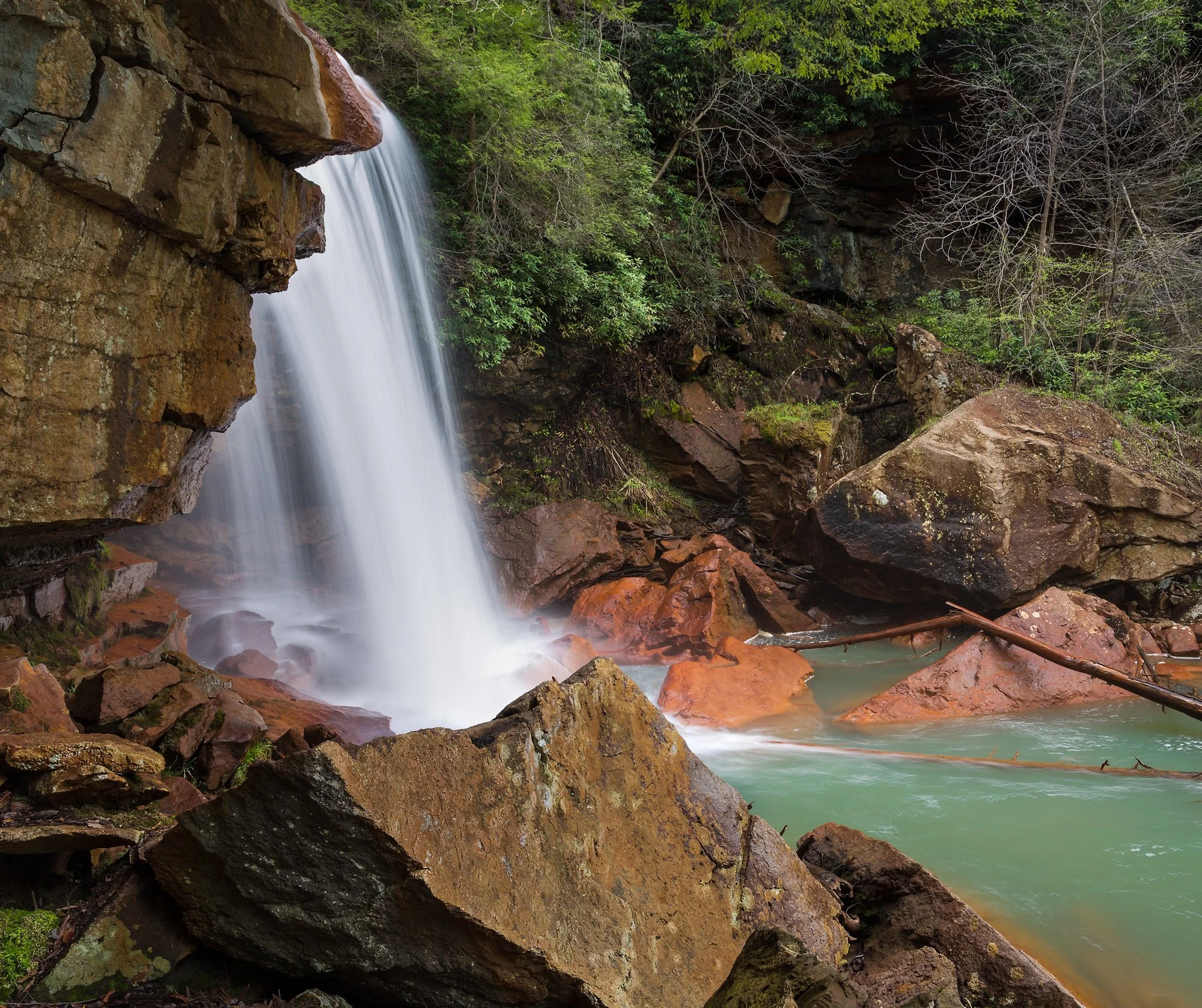
Side view of Douglas Falls, showing stained rocks and toxic, heavy metal laden water, 2014
The orange rocks and aquamarine water at Douglas Falls are not the colors of a healthy place.
They are both signatures of acid mine drainage (AMD) — the chemical legacy of the coal mining that shaped this region for over a century. When sulfide minerals in coal seams and waste rock are exposed to water and oxygen, they generate sulfuric acid. That acid dissolves metals from the surrounding rock as it travels. The orange staining on the rocks is iron hydroxide — the deposit called yellowboy, one of the most recognizable markers of AMD in Appalachian streams. The North Fork of the Blackwater runs through a watershed that has been absorbing this chemistry since the 1880s, when deep coal mining and coke production first transformed the stretch of river between Thomas and Douglas. The damage is not incidental to this landscape. It is structural, and it is old. The aquamarine in the water comes later in the chemical progression: as the acid continues downstream, it dissolves copper and other heavy metals, which precipitate out as the vivid blue-green that photographers find so compelling.
That aquamarine, in other words, is not a sign that the chemistry has resolved. It is a later stage of a toxic progression — and by the time the water looks most ‘beautiful,’ it is carrying a heavy metal load. Mercury, lead, and arsenic have been documented in this watershed. The water is acidic and largely lifeless. Where you would expect to find mayflies, stoneflies, and caddisflies — the sensitive invertebrates that form the base of a stream's food web — there are almost none. Where you would expect native brook trout, there are none. The hemlock forest above adds its own note of ecological distress, as the invasive hemlock woolly adelgid continues its slow devastation of the hollow's canopy. What looks, in a photograph, like an enchanted and improbably luminous place is, ecologically speaking, a wound.
None of this is visible in the images we make there.
